Talk to Strangers

We live in a world of strangers far from a time when children rode their bikes freely through the neighborhood, no helmet, hair blowing all over, careening around corners and feeling the world was simply wonderful, that God had created the day just for them. Life was innocent. The local policeman (no, we did not use the word cop) was a friend, someone to go to if one was lost. Adults smiled at little children and they smiled back because adults were seen as nice and caring and there was no distrust. It was all very good.

Now things have changed. Children and adults are discouraged from talking to strangers. The humor of the day is sharp and often caustic. The world has grown dark. Sadly, ‘good’ parents make their children wear helmets and knee pads and shield them from skinned knees. Tree climbing is often prohibited and replaced with the favored choice of screentime. No bones are broken there, only minds and souls and no one sees.

But sometimes, if you will allow yourself, you will find that talking to strangers brings serendipitous results. Sometimes, your world is changed by a chance meeting.

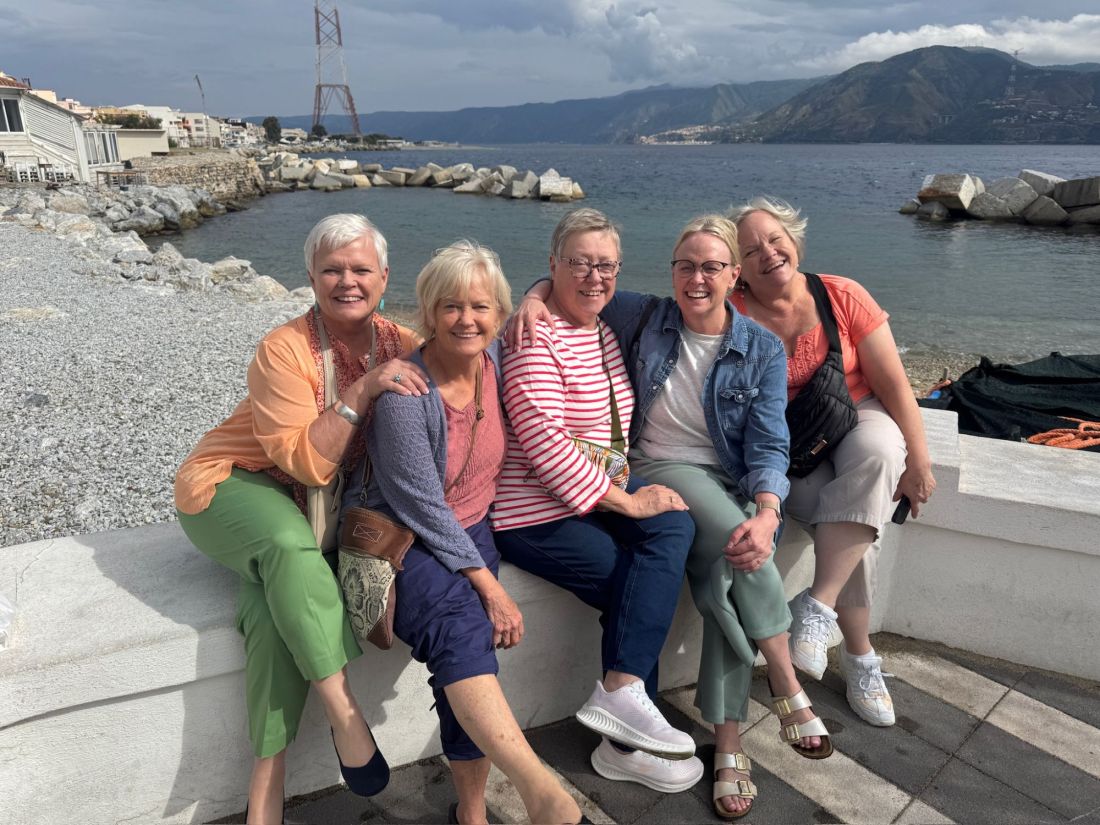
We were in Messina, Sicily, my sisters and I. We had arrived late at night and in the morning set out to explore the area. Five girls, Jeannette and Herby’s girls once again, walking together. The streets were narrow, walled with apartments in this area of the city. Turning a corner we noted a sign for a little grocery and headed in that direction. We needed some coffee, of course, and some sundries. Standing in an aisle I noted a couple – an attractive woman and her husband speaking English. And so I did it, I talked to a stranger. And talking to that stranger changed our whole week.

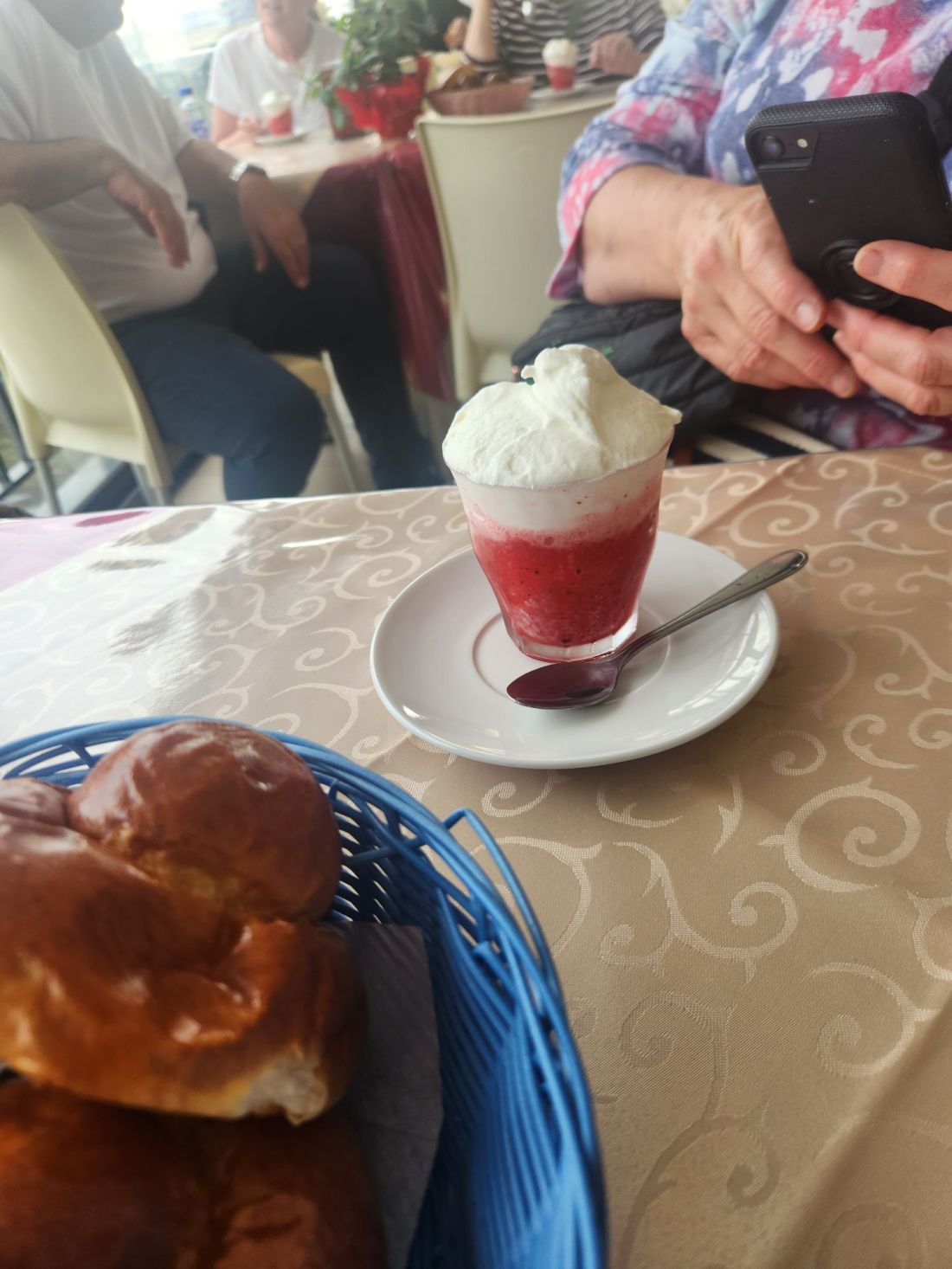
We did not know when we asked John and Debra where things were in the store, that they would so graciously open their world to us – John, a true Sicilian and Debra, his lovely wife. Before we knew it they had invited us to dinner at the local cafe. And soon John was making plans for our week. They would meet us for garnitas and brioche in the morning, then travel with us by bus to downtown Messina; they would show  us the sites and sounds of the city. We  would eat Sicilian street food and visit the Piazza Duomo with the world’s largest astronomical clock. Oh, the tales John can tell! He is the ultimate Sicilian with a bit of Montreal Canadian thrown in along with admiration for America. As well as Sicilian, he also speaks, French and English and as he shared his rememberances of his summers in Messina we could picture a beautiful little boy running the streets of the city, happy to be visiting his grandparents – his nonna and nonno. He was the perfect guide.

These friends, no longer strangers made sure we were taken care of, even texting us when we drove the two hours to grandfather’s village to make sure we were okay. Debra took pictures and made multiple videos of our journey. She delighted in sharing information with us and took us under her wing. Our last evening in Messina was spent at the cafe with Debra. A perfect way to end our stay before heading south to Catania.

Webster’s tell us serendipity is finding valuable or agreeable things that are not sought for. They come upon you unawares. John and Debra were our serendipitous people, full of kindness and generosity. How sad it would have been if we had kept to ourselves and not talked to strangers. The joy we would have missed.

As I sit here this evening in my quiet Arizona casa drinking tea from the cup I purchased on our ‘field trip’ to Messina, I can’t help questioning the ‘wisdom’ of our present culture. Maybe we need to talk to strangers. Maybe the world is a much kinder place than we thought. If not, maybe we can change it. Maybe we can be that person that smiles at someone in the grocery store or helps an elderly lady with her bag. Maybe we can laugh instead of discouraging that little boy riding down the road without a helmet, rejoicing in childhood. Maybe each one of us can be someone’s John and Debra. For the good of our souls and the souls of others, maybe we need to talk to strangers.
Guiseppe’s Village Pt~III

“Girls, this was a great day.” My sister’s pronouncement as we sat around the kitchen table in our VRBO in Messina, Sicily was met with smiles of agreement. It had been a long day. We rose early in the morning. This was the day – the day we would actually visit the little village of San Stefano di Camastra, the home of our grandfather. We did not know exactly what we would find. It could be something great – or it could be nothing at all.

Our week has been full of wonderful experiences. Yesterday, our new friends, Debra and John, the very best of people, took us to downtown Messina. Arriving at the Duomo di Messina, the beautiful music of Ave Maria burst forth as the world’s largest astronomical clock shared its display of figurines. What a beautiful way to start the day! From there we traveled on to the street food celebration in the center of the city. Oh, how we have come to enjoy these two in the short time we have known them. John, though Canadian by birth, spent his summers running freely through the streets of Messina as a boy, spending summers with his grandparents. He is the essence of all things Sicilian. Debra stepped in to document our day. These two together have enriched our journey. They are gifts from God.

The two hour drive along the coast of the Mediterranean today was filled with talk and laughter. We continue to be surprised that we were all able to leave our busy lives and join this adventure. Marjorie navigates as I drive. Dosh tries not to look at the edge of the mountain we’re driving across. Vivian and Karen chat along. All together in one place, that is us.

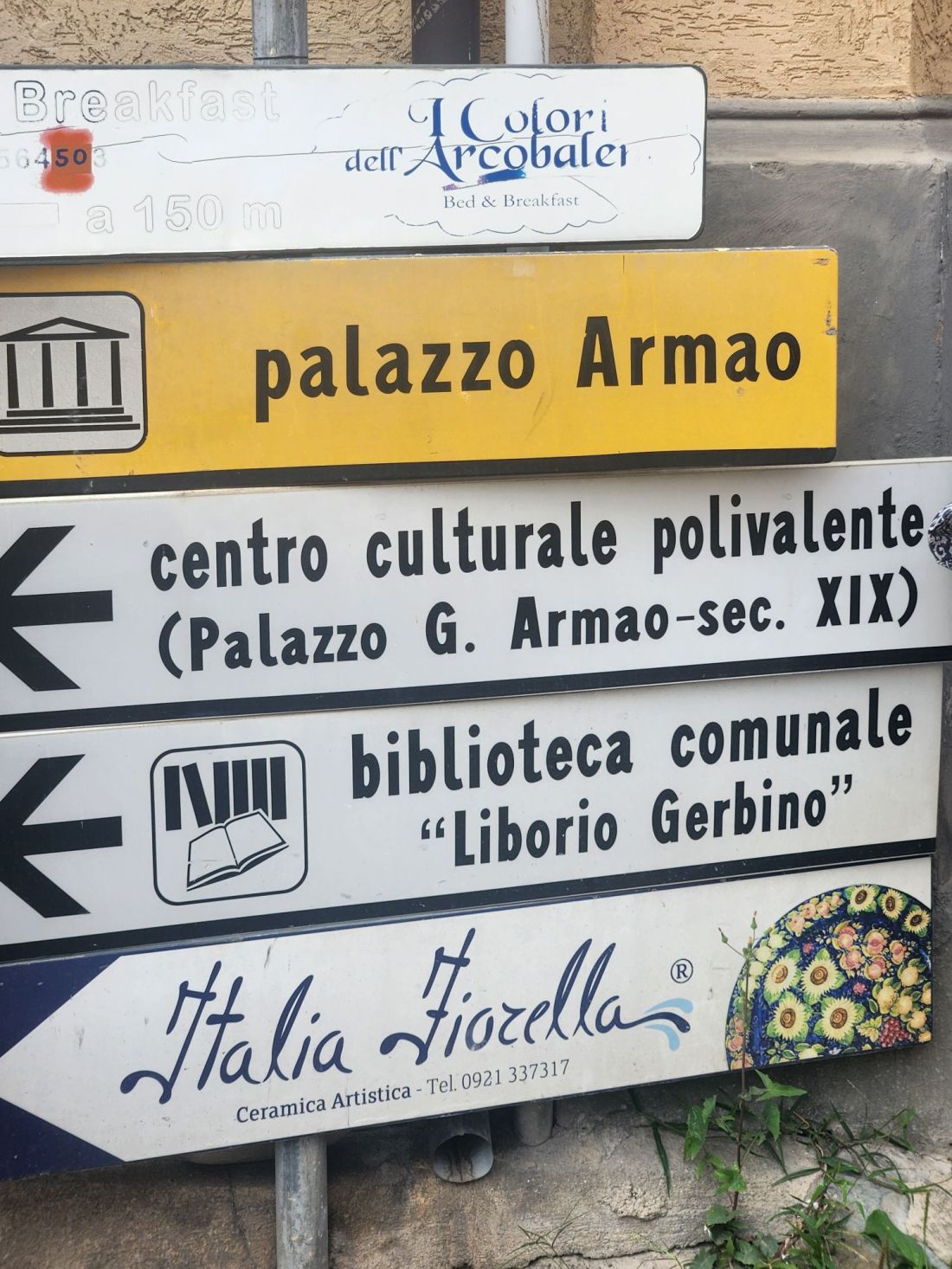
And now it is time. Signs for San Stefano di Camastra direct us off the coastal road and into the village. It is a beautiful village with crowded cobblestone streets ~ just as it should be. Parking our car, we ask a passerby if he knows where Via Armao is. We have been told this is an actual street. And it is! We have found our street! We are overwhelmed. It is true! But wait. There is the sign for the Armao Palazzo.

Up the street we go to find Palazzo Armao built in the architectural style of the late 19th century. It is here that we see a sign for the library and step inside. A young man working inside greets us. Using Google translate, we explain our mission. We are five sisters looking for our grandfather’s people, the Armao family. His eyes grow wide.

“Armao! Yes, the Armaos are a great family. They were a very important family. They were very wealthy and gave much to the poor. They were very intelligent and leaders. Come, let me show you your library.” He speaks with great respect.

Our eyes are full and our hearts overflowing. Yes, Davide tell us, there are still Armaos here and some in Palermo. We chat with Davide a bit longer before heading out the door, thanking him profusely and smiling to each other. We are amazed. It is all so very good. Tears well up as we think of our father and our grandfather. It is wonderful.

We must visit the ceramic shop. Our great grandfather was a potter making beautiful ceramics which San Stefano di Camastra is known for. We visit various people around the village. Yes, the Armao family was the backbone of this community and is still held in high regard. It is a beautiful village, full of potters and lovely ceramics. These are our people. And though it is siesta time, we find an open shop to buy some ceramics. Sebastian welcomes us to his shop. He shows us his kiln. We buy San Stefano ceramics and he tells us about the Armaos. Everyone knows us!

Oh, how we wish there was more time. But we will have to leave to travel the two hours back to Messina. If only we could have met our famiglia in person! But that is for next time. They will be here. As we journey home we talk of our parents and how happy they would be to know we have done this thing.

Now we know Messina; this evening we walk the streets of our area to the cafe to enjoy pizza together and then we call our siblings in America. We have found them! We have found our people! Our hearts are overflowing with gratitude for all of the good of this week. God has been kind to us as He opened each door to make our journey successful. It is more than we would have imagined. It is all so good!

Tomorrow we will walk to breakfast with John and Debra at our lovely outdoor cafe, swim in the Mediterranean, and attend mass at the little church here on the outskirts of the city. Then, it’s off to Catania in preparation for our flight home, far away from Guiseppe’s village.

We will be back. We will drink espresso at the little cafes, walk the streets of our village and meet the remaining Armaos. We are so happy we found our famiglia. Arrividerchi for now, but we will be back, dear Guiseppe!

Part II ~ Guiseppe’s Island

“There are only two types of people in the world, those who are Sicilian and those who wish to be.” So says John, the marvelous Sicilian Canadian whom we met as we meandered through the streets of Messina this morning.

We gathered in Philly, we five, we band of sisters. It began with one sister and as the day progressed she was joined by another and another and another and another until we were all together in one place. Then, it was on to the plane – 8 hours to Frankfurt then on to Catania. Five sisters in a row.

An overcast sky met us in Catania and as we landed, Marjorie looked at me, “Here we are in the land of our grandfather.” Gulp.

Yes, here we are. Driving the two hours from Catania to Messina over winding roads on a dark night in a heavy rain, was an experience. Thank God for GPS! We arrived in the dark at our VRBO on a crowded street not far from the Mediterranean. As we piled out of the car looking for our casa, a lovely Signora stepped out of a door and called to us. Guiseppe’s granddaughters had arrived.

Our first foray was to find some food late this morning. We found a small bakery where we purchased a few rolls and explained to the older Italian woman that we were looking for our grandfather’s birthplace. Walking from the shop we heard a voice calling us. It was a young man sent from the shop to bring us more rolls — after all, we are daughters of Sicily and we must be cared for.

At the mercato we ran into John and Debra, oft visitors to Sicily. John speaks Italian, even Sicilian Italian (!) and has family on the island. And before we knew it we were sitting outside at a lovely cafe eating lunch with our new friends, the Mediterranean shining under the sun and mainland Italy (the tip of the toe) across the water. Archini, foccacia, insalata with prosciutto and mozzarella decorated our table and laughter and conversation flowed freely. Can we really be here for one day and feel so comfortable?

Tonight we will sit around our table in the mountains of Sicily, drinking strong coffee, eating our fresh rolls and sharing our lives. Guiseppe didn’t know over 100 years ago as he boarded the ship for America, just a small boy of 10, that his granddaughters would talk of him and remember him and travel to find his village. We are here, grandfather! We are here!

Finding Guiseppe ~ Part I

“I’m not eating any sardines!” my eldest sister exclaimed!

The video call was full of laughter and argument, each trying to get a word in, as my sister made her pronouncement.

It all started last spring when I messaged my sisters. “I’ve got points! Let’s go somewhere.” Before we knew it we were researching our grandfather Guiseppe and planning our journey.

We live in various parts of the country from the northeast to the southwest but we will travel together ~~ the town mice and the country mice off to explore the world. I see us now – seated in one long row talking and laughing as we wing our way aboard Lufthansa through the friendly skies to our destination – Sicily.

Years ago, our grandfather, just 10 years old, traveled aboard a ship to the dream of America. Forty years later, our father flew over Sicily as a tail gunner, ridding the world of Mussolini and freeing Italy. This week, our father’s daughters will return to Sicily, touch the earth, dip toes in the Mediterranean, travel to Mt. Etna, and visit our grandfather’s village.

If Mom and Dad could see us, they would smile and be happy for us. They would laugh at our foibles. They knew each one of us better than others do. After all, we were theirs before we were anyone else’s.

We’ll eat pasta and cannolis, croissants and gelato and though she doesn’t know it, I’m sure Dosh will even eat sardines!

~~End of Part I ~~

Keep An Eye Out for Part II

Church in the Valley of the Sun

AMEN

Lessons From My Mother

Richer than I you can never be; I had a mother who read to me. – No, that was not the case in our home growing up, for our father did the reading. Our mother sang. She sang her way through life and along the way dropped morsels of wisdom I never noticed until she was gone. She lived a busy, full, exhausting life and then she stepped out and left me with far more goodness than I deserve. The mother I knew – and of course in a family of nine children, each child experiences their parent differently – the mother I knew speaks to me daily, for I carry so much of her in the way I view life and the things I hold important.

My older siblings remember a time when our mother did not work outside the home. Some remember coming home from school to hot bread, fresh from the oven. That was not the experience for the last of us. MY mother arrived at 4:30 each afternoon, dressed in a white nurse’s uniform complete with white hose, white shoes, and her elegant nurse’s cap perched neatly on her head. She would have her hair done once weekly at the beauty parlor for she must look her best. She took great pride in her appearance and profession as a nurse. How well I remember attending our mother’s capping ceremony. It was a magnificent accomplishment for her and we, her children, along with our father, were there to honor her. You see, she did not start her nurse’s training until after the birth of her ninth child. The mother I knew worked full time, sang in the choir, sewed dresses for the holidays, fed the masses (that would be us), welcomed people into her home….my mother, in her everyday life, did so many things, and just when I think I’ve remembered them all, someone tells me of something else she did. I found this out when speaking to a colleague of hers, another nurse, after her death.

“Oh! Your mother was ‘The Singing Nurse’. That’s what she was known as in the hospital. She helped me through the hardest time of my life.’

So this was what my mother was doing while I was at school and completely unaware. I thought she was simply doing her job and then coming home to us at day’s end with fruit she had picked up at the P&C. But no, my mother loved people and so she must always have an open heart and an open door, for we had many people in our home over the years. And truly, no matter what society says, it is the lady of the home who creates a welcoming atmosphere.

When I look at the parents of today, so afraid they might not do things right, so afraid to let their children out of their sight, so afraid to let their children simply BE without being entertained, so afraid of EVERYthing, I wish they could sit at the feet of my mother. She approached each day with a common sense attitude. There were no podcasts to listen to to give her advice on mothering. She simply parented with a confidence, not in herself, but in the fact that one must do what must be done and with the humility of knowing things would not always turn out right, but that was to be expected. God was in His heaven and all would be right with the world even when things were hard. Now, parents stress and cause their children to stress over the littlest things. In a world that professes to let go, we are holding on to control more tightly than ever.

I admire my mother for her fortitude, for the complete confidence that we would be alright as we spent our summers running through the fields, swimming in the ponds, climbing trees, and much too high in the haymow. We rode high atop hay wagons, burdened with far too many bales, having no sense of fear as we swayed back and forth. We ran down the lane to find the cows who came running at the sound of our voices, eager to be fed and milked. We rode our bikes and horses skinning our knees and galloping at the fastest speed our little horses could manage. And she let us! She let us! I will always be thankful to her for this. She was not the prissy mother, allowing only two cookies per child and nagging with unneeded correction. When my mother corrected me, it was because I needed it. Few and far between were those corrections, which is just as it should be when the correction is honest and true.

She was not a person without standards. There were certain things that were extremely important to her and I learned to treasure them. They are standards in my life today. We must love music. It was her doing that drove me to learn to play clarinet and piano – never a maestro in either. I remember those Thursdays getting off the schoolbus and trudging up the long walk to the parsonage so Mrs. Colson could teach me. What patience she must have had. And later, when it was time to continue with piano and voice lessons, there was the wonderful Mr. Mobley, a true gentleman, who would patiently guide me through ‘Swing Low, Sweet Chariot’. There were musicals on the record player and Jerome Hines and George Beverly Shea singing beautiful hymns. I listened to her sing Ave Maria as her friend’s son was married. And once, in my memories of long ago, I watched my mother join a choir to sing Handel’s Messiah. When I was 13, it was expected that I would join the choir, for we were a singing family. This was the world my mother opened to me.

Without a word, she walked me into the value of tradition and respect for beauty as each holiday, tucked up in our very rural corner of the world, we took part in special observances — Christmas mints must always be put out along with nuts for cracking. The Currier & Ives china must always be used. It was she who reminded us of our Norwegian heritage when we helped to make the sandkaker or stood watching her make the krumkaker. I think of her when I make these treats even now. I have quoted her admonition to my own children — ‘Make sure you don’t make the sandkaker too thick!’ They are hearing her through me. She has spoken to them so many times over the years and I am honored to repeat her words.

Yes, my mother, without ever noticing, taught me many lessons of life. She was strong and faithful, with a tremendous sense of humor which stood her in good stead. Even this was a lesson. So many people in our present society have lost their sense of humor. I suppose it comes from thinking too highly of one’s self. Not my mother. She knew how to laugh – at herself and at others. With her quick wit and love of wordplay she equipped us with a knowledge of language that has served us well. How many times did she tell us we must clean up for ‘You look like the Wreck of the Hesperus’. Of course we knew that was a poem by Henry Wadsworth Longfellow about a ship that had wrecked. How many little poems and ditties she taught us, all of them sharpening our use of words and without any spoken admonishment, leading us more deeply into an appreciation of language.

Sometimes I think the art of parenting is a vanishing art. It is not because it is impossible. It is merely that society has changed. Whatever the reason, there is a great temerity in parenting in these present times. It makes me remember once again that lessons are often not spoken, but rather lived, and that we ought not rely upon our words as much as our actions. Traditions, routines, example – these are the tools of learning. Parents don’t have to be perfect, just committed, as was my mother.

And there is one more thing, one very little big thing —– there is love. With all the busyness of life, me in school, my mother working, entertaining, singing, living…..she loved me. She loved us all. We never doubted her love. Not the frilly, silly love we hear so much about today. This was the day in, day out, I’ll be there in the good and bad times love. The love that expects something of you because they treasure you. The love that gives its all. There is a great confidence that grows in the heart of a child when they are enveloped in this kind of love.

Can it really be forty years since she stepped from this world to the next? For it seems she is still here, teaching me every day. I look forward to all I have yet to learn.

Featured

Learning to Love Words – A Legacy

Maresy-doats and doesy-doats and little lambsy-divy.

A kid’ll eat ivy too – wouldn’t you?

This was one of the nonsensical songs my mother would sing to us in our childhood. Of course we would chuckle for we knew the next line was coming, which would explain the first.

If the words sound queer and funny to your ear, a little bit jumbled and jivey,

Just say mares eat oats and does eat oats and little lambs eat ivy….

Words were our parents’ toys and it was only natural that we became comfortable with language early on. Growing up in a home that eschewed the television because our father could see into the future to a time when the box at the front of the room would draw the attention from all else, we were left with ‘only’ words — the written word, the spoken word, and the words that were joyfully sung.

A flea and a fly in a flue were imprisoned

So what could they do?

Said the flea, Let us fly!

Said the fly, Let us flee!

So they flew through a flaw in the flue.

Oh, how I remember trying to learn this little wordplay as a child. With all the homonyms, it certainly made a young child’s mind think! And think we did. We wrote poems, sang songs, read books…

We never noticed the great thing our parents were doing in equipping us with a love of language. We did not think it odd when our mother would tell us to clean up because we looked like ‘The Wreck of the Hesperus’. We knew that was a Longfellow poem about a shipwreck and we must do just as she said. I once referred to this in a class I was teaching and the poor unfortunate souls looked at me in confusion. For all the ‘progress’ of enlightened, modern education, their lack of knowledge took me by surprise. I thought everyone grew up surrounded by Jabberwocky and walked down the beach with the Walrus and the Carpenter.

The language of hymns lifted our vocabulary and increased our understanding of words as we sang:

Though the angry surges roll o’er my tempest driving soul,

I am peaceful for I know, wildly though the winds may blow,

I’ve an anchor safe and sure, that shall evermore endure.

And it holds, my anchor holds

Blow your wildest then o gale,

On my bark so small and frail,

By His grace it shall not fail,

For my anchor holds, it firmly holds.

At Christmastime, we learned history as we sang the words of Longfellow written during the dark years of the Civil War, struggling with his sadness at the division of the country and expressing his hopefulness when he writes –

And in despair I bowed my head. There is no peace on earth I said.

For hate is strong and mocks the song of peace on earth, goodwill to men.

Then rang the bells more loud and deep, GOD IS NOT DEAD NOR DOTH HE SLEEP.

The wrong will fail; the right prevail with peace on earth goodwill to men!

Oh, it was so easy to believe when we were surrounded by this goodness, this beauty, this use of language! Chesterton, that great British author was not afraid to speak about words:

Our generation professes to be scientific and particular about the things it says, but unfortunately, it is never scientific and particular about the words in which it says them. It is difficult to believe that people who are obviously careless about language can really be careful about anything else.

Our dear Chesterton is correct – and to think he died in 1936! Ah, but he was a man of words and could see what was truly coming down the pike. He knew that standards in speech are important and one of the ways we establish order in a society. When language falters, we are less likely to understand one another. Without rules of speech we do not present ourselves well and this often leads to coarse or underdeveloped use of words. Without an ability to converse, chaos reigns.

There are arguments that can take place peacefully. We call them discussions. However, without the ability to communicate clearly we will never be able to have them! Chesteron notes this also, when he says:

What is the good of words if they aren’t important enough to quarrel over? Why do we choose one word more than another if there isn’t any difference between them? If you’re not going to argue about words, what ARE you going to argue about?

Ah! This man is speaking my language. How many nights around the dinner table did talk reign supreme with opinions freely given – very freely given, for we were raised to speak our minds and we certainly did. Man or woman, boy or girl, each had words to say. Our parents viewed us with the respect granted a child of God and we would never take advanatage of that. We knew there were times to be seen and, respectfully, not heard, but that we would also have our time to speak.

My father’s last words to me arrived in a card a few days after his death. I treasure those words. They are worth more than any amount of money. The words we exchanged over tea, the everyday discussions of what flowers or vegetables he would plant in those last years of his life, are precious and gentle remembrances of time well spent.

Now, whenever I sit in a crowded room or around a table and hear conversation flowing around me, whenever I am part of that conversation, I am reminded that my wise parents presented me with a feast of words, a love of language, and I am reaping the benefits daily. That, my friends, is what we call a legacy.

Featured

Once Upon an Evening

As any family, in our grown up years we find ourselves scattered across the country and sometimes across the world. But every once in a while we feel the need to gather– to hear the familar voices of our siblings. We’re an opinionated bunch, most large families are. We learned early the old adage, speak now or forever hold your peace. and believe me, we can speak! And so we found ourselves one weekend smack dab in the middle of the country…

Here we are, all together in one place, sitting on my niece’s bed which she has so kindly provided for this weekend. I am looking at my older sister and listening to her talk.  My brother sits next to me as our little sister leans against the pillows.  It is late and we have traveled far. We are friends, borne of family and choice and we are savoring every moment of this night as we laugh and talk and catch up on each other’s lives. We are children grown up, laughing and talking and chiding as children do.

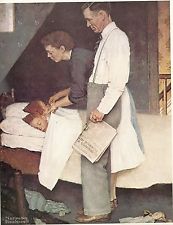
There was no plan for this late-nigrockwell parents with childrenht meeting.  It is a serendipitous moment seldom found in the rush of adulthood. We were unaware when we stepped off our planes and hugged each other, that after all the chatter of the evening we would drift into this room to renew our acquaintance with the past.

Years ago we ran together through the fields of upstate New York, towheaded and barefooted, skin the color of gently roasted marshmallows. We climbed up high in the barn for the tomboy contest and swam in our old pond, murky as it was. In winter, we dragged our trusty toboggan up the big hill to come flying quickly down, piled one behind the other, screaming with fear and enjoyment. We walked through tunnels of snow, dug from our house to the road, to climb on the school bus during those cold, dark winters, and picked apples in the back field at the end of beautifully sunny summers. We picnicked at the creek and picked out Christmas trees from our own fields.  We savored wild strawberries, their tiny size betraying nothing of their enormous flavor. We delighted in our own names for our own fields – the flat, the hill, the harp, the knoll, the pool table, the lane – we knew them all. We knew the best place for blackberries and became experts at stringing raspberries on tall Timothy grass.

We learned to state our opinions at our kitchen table where our parents encouraged us to think and talk. We learned to sing around the piano and did not fear the sound of our own voices. We grew strong and confident never realizing the depth of relationship developed over those glorious years. And, as most children, never noticing the great work our parents were doing in our lives every day. Now, as parents ourselves, we are kinder and more understanding of our own parents and we love them even more as we understand their lives and their decisions.  We are now them. They are seen in us.

We have gathered in the middle of the country to celebrate many things, our parents, our connection to one another, a triumph of health…..there is a gratefulness to us in this meeting. We have learned, over the years, that our gatherings are never to be taken for granted and so we treasure every moment together.

Yes, here we are, thankful children, talking late into the night, with no mother to scold us or father to direct us. Yet we know, if there is a way to see us from that heaven up above, they are smiling and enjoying their children gathered together under one roof again.

Featured

Growing People

When I was a little girl, I helped my father plant a garden. He was a master gardener, not in the sense of taking a course, although he held a degree in agriculture. No, he was a master gardener in the fact of loving plants, and loving the process of gardening from beginning to end. Before the seeds were planted, the earth must be tilled, the little tractor pulling the plow, disturbing the rocks that grow so well and turning over the soil.

My father knew the ground would need to be turned over several times, that fertilizer must be mixed in. He measured each row, tying string to stakes at each end to ensure the rows were straight. Each row was hoed just deep enough for a seed to be planted, but not so deep that the seeds could not grow. I walked along dropping corn kernels in the row, strategically placed, two at a time. I loved the bright pink color – at that time corn was treated before planting. We must be careful not to put the kernels either too close or too far apart. Cucumbers, squash, and pumpkins were different. THEY must be planted in small mounds and given freedom to roam. We worked together, the children doing their part, my father leading the way. This was his specialty and my mother was nowhere to be seen. She loved her music. He loved his plants and books. They poured their seeds of music and nature into our lives and, though we never noticed, they were growing us all the time. We were just some of the things they grew.They found great solace in escaping city life, in buying a simple country home, and surrounding us with music, books, animals, and large vegetable gardens.

We looked forward to the time when the corn grew high and ripened, tassels turning brown and a summer evening consisted of shucking the ears, boiling the corn, slathering it with butter, sprinkling it with salt, and feeling the soft kernels pop as the juice ran down our chins. The room was full of laughter and talk and life was simple and good.

It was August and school would not begin until after Labor Day. It was a distant thought. As children, we did not realize the beauty of this experience, foolish as we were. We did not realize these days would be treasured in years to come – and that was just as it should be, for children do not need the burden of being made to appreciate the everyday-ness of life. They must be allowed to live each day fully and memories will appear in their older years, when they are needed.

During the winter months, in between reading Solzhenitsyn or Louis L’Amour in front of a roaring fire, and journeying with us through the Little House books, our father studied his seed magazines and planned his garden. The gardens grew as the years went by, to include three separate glorious spaces. Gourds were grown simply for their beauty, laid out to dry, and then to be shellacked to a lovely shine and shaken with vigor by certain children to hear the seeds rattle. These were used purely for decoration and enjoyment.

As I look back on this now, I realize this was not an unusual experience for the time and area in which I grew up. Families often planted their gardens together and children seldom had time to contemplate the boredom that is so rampantly expressed in our present age. There were weeds to pull and, later, vegetables to pick. Summers days of wandering through the fields, a stalk of Timothy grass hanging from one’s mouth, feet and head bare, were the norm. Sunscreen was unheard of, a burdensome invention yet to come. We felt the sun warm our bodies and lifted our faces for its blessing.

Without television or screens of any kind, I wandered happily over the hills never realizing the charmed life I’d been granted. And yet, I did not disdain it. There was a joyous feeling to picking tiny wild strawberries with my siblings in the middle of a wide, open field. All in all, life was good, free of worries, full of hope. We did not choose to be grateful, we simply were.

Now we live in the terribly enlightened year of 2022. Screens abound. Children must be instructed to play in the fresh air. Social media has taken the place of kitchen table discussions. Friends are too busy to drop by. Strawberry fields have given way to housing developments. It’s a brave new world where twenty-somethings exchange looks of disdain for their elders’ lack of wokeness and breathe a sigh of relief that we have escaped the gentle life of all that was truly good and beautiful. Now, we must schedule our times of reflection if that is even to be.

As for me, I’m holding on to gratefulness. I’m choosing the wide open country and walks into good books. I’m looking for wild strawberries and kitchens full of friends and neighbors. I’m hoping the Wendell Berry life is still available and I want to invite all who wish, to come away with me. There are still so many lanes to wander, so many trails to explore. I want to grab the hands of all those woke disciples and lead them to the land of plenty — no shoes, no hats, no sidewalks, just the good fresh air and the folks you love. I dare any screen or tight schedule to compete with that.